

Brave New World by Aldous Huxley
"A masterpiece... one of the most prophetic dystopian works." —Wall Street Journal
Now more than ever, Aldous Huxley's enduring masterwork must be read and understood by anyone concerned with preserving the human spirit. This celebrated classic is now available as a Harper Perennial Olive Edition.
Aldous Huxley's profoundly important classic of world literature, Brave New World is a searching vision of an unequal, technologically advanced future where humans are genetically bred, socially indoctrinated and pharmaceutically anesthetized to passively uphold an authoritarian ruling order, all at the cost of freedom, full humanity and perhaps the soul itself. Described by The New Yorker as a genius who spent his life decrying the onward march of the Machine, Huxley was a man of incomparable talents: equally an artist, a spiritual seeker and one of history's keenest observers of human nature and civilization.
Brave New World, his masterpiece, has enthralled and terrified millions of readers and retains its urgent relevance today, both as a warning to be heeded as we head into tomorrow and as a thought-provoking, satisfying work of literature. Written in the shadow of the rise of fascism during the 1930s, the novel speaks just as directly to a twenty-first-century world dominated by mass entertainment, technology, medicine and pharmaceuticals, the arts of persuasion and the hidden influence of elites.
This book is featured on The Book Club with Michael Knowles, PragerU's show dedicated to the great books of Western civilization. In this episode, Michael Knowles is joined by Sen. Ted Cruz to discuss why Huxley's dystopian vision stands as such a powerful indictment of tyranny and totalitarianism.
📺 Watch the episode: Sen. Ted Cruz — Brave New World by Aldous Huxley
Read Aldous Huxley's prophetic classic of a world that traded freedom for comfort, and discover why its warning still feels urgent nearly a century later.

Customers praised this dystopian classic as "thought-provoking" and "eerily relevant" to modern society. Many said it explores themes of freedom, control, and happiness through compelling philosophical debates. Reviewers appreciated the "elegant writing" and timeless ideas, though some found characters wooden or pacing slow. Several noted Kindle formatting issues with missing characters.
- A literary masterpiece that grabs you from the very first page and refuses to let go.
- Such an amazing book! A beautiful insight into society, control, and freedom.
- Absolutely thought provoking! One of my favorite dystopian books!
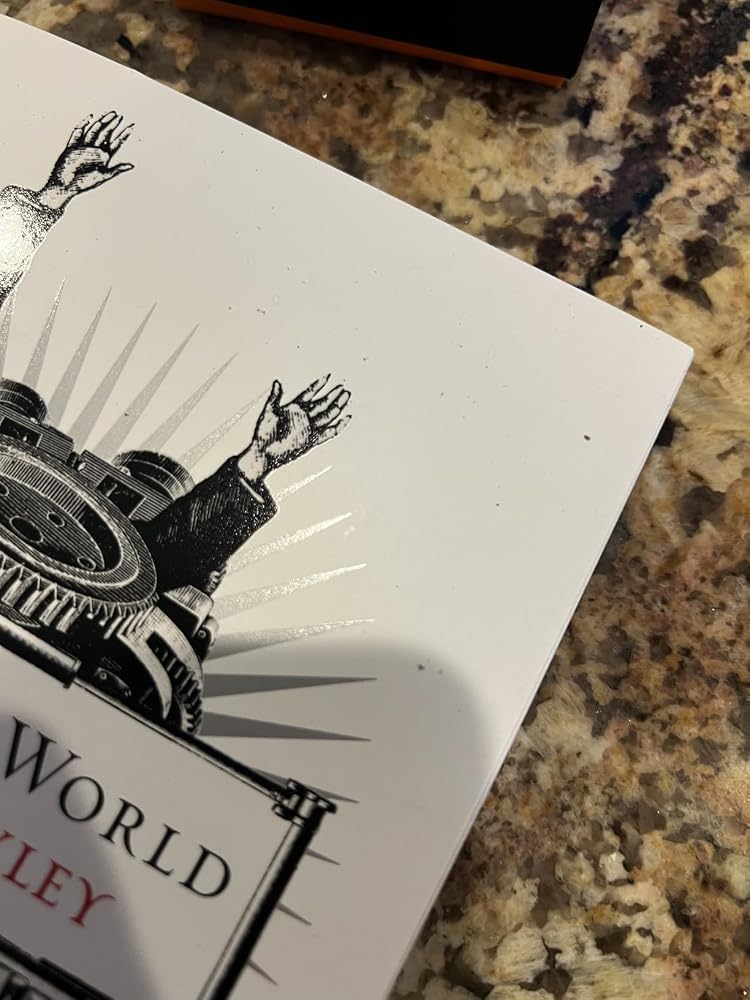
Came in right one time and in good condition . Only thing is it has some like spot marks on it ? But I don’t really care as long as I can read it lol.

I wonder what it was like for people to read and talk to Huxley before time and technology revealed how ahead of his time he was? In the year 2002 we've come to believe just about anything is possible as technology steamrolls through our lives and pretty much over us."Brave New World" is as relevant today as it was when it was written. Pershaps more so. Why? Because we now know its more fact than fiction.Thinking Man vs. the conventional mind has and will always be the great divide. As technology offers more entertainment and caresses (the ability to keep us contented and happy) the more we give up as thinking, feeling beings. The more alien we become to our nature."Brave New World" offers a glimpse into where we might be headed. I, however, still believe the social/econimic divide will make this a much more unstable and dangerous world than "Brave New World" allows for.Books like "Brave New World" will be eliminated (as much as possible) in this world, and the need for such books, though much greater, will become pornographic and subversive excursions shunned by a proper and polite society that does not read such rude and disgusting ****."Brave New World" is a fast read that leaves you in a state of limbo when you turn the final page. So much happened so fast that you now need to let it churn in your mind. You need to ask yourself some important questions on how this affects you and the future of humankind.Read it, reread it, then think, then do something! Otherwise....
I never read this book in high school like I should have. So I thought I would get the audio cassette version. Well I can tell you that I thoroughly enjoyed it. Michael York does an excellent reading although his girly voices will make you laugh at first.I guess if I had read this when I was in high school I would have never realized what an anti-communist book it was. I would have thought that it was a sci-fi book with all the cool helicopters and other transportation devices. The impersonal part about baby factory made me feel cold. I couldn't imagine growing up with no relatives or not knowing who your family was. The morality with all the people having **** all the time was different except for the fact that you were not allowed to have the choice not to have **** if you didn't want it.The savage's lives were a little too moralistic for me but I guess it was written in the 1930s. He just over emphasized his feelings of love and was too appalled by people having **** all the time.The overall message was insightful still showing how it is always better to have freedom of choice then to be bound to the collective.This is a good book or tape for high school age people to listen to.
This Utopian/dystopian future offers soma and other carnal pleasures, while manipulating the people into mind-numbing dependence. Huxley explores the evils of a seemingly satisfied and successful society, because that stability is only derived from the loss of freedom and personal responsibility. Part of what has made this book so controversial is the very thing that has made it so successful. We want to believe that technology has the power to save us, but Huxley shows the dangers as well.John claims the "right to be unhappy." Mustapha says it's also "the right to grow old and ugly and impotent; the right to have syphilis and cancer; the right to have too little to eat; the right to be lousy; the right to live in constant apprehension of what might happen tomorrow..."By getting rid of all of the most unpleasant things, the society also rid itself of many of the true pleasures in life. There's no real passion. Remembering Shakespeare, John says:"You got rid of them. Yes, that's just like you. Getting rid of everything unpleasant instead of learning to put up with it. Whether 'tis better in the mind to suffer the slings and arrows of outrageous fortune, or to take arms against a sea of troubles and by opposing end them... But you don't do either."These men have realized that fear and intimidation have only limited power; after all, these tactics simply build up resentment in the minds of the oppressed. Subconscious persuasion and mind-altering drugs, on the other hand, appear to have no side effects. Add to this the method of genetic engineering, and soon almost all "pre-Ford" problems have been wiped out permanently.The caste system of this brave new world is equally ingenious. Free from the burdens and tensions of a capitalistic system which separates people into social classes by natural selection, this dictatorship government is only required to determine the correct number of Alphas, Betas, etc., all the way down the totem pole. There is no class warfare because greed, the basic ingredient of capitalism, has been eliminated. Even Deltas and Epsilons are content to do their manual labor. This contentment arises both from the genetic engineering and the extensive conditioning each individual goes through in childhood.Freedom (as well as art and religion which are results of freedom) in this society has been sacrificed for what Mustapha calls happiness. Indeed almost all of Huxley's characters, save Bernard and John, are content to take their soma ration, go to the feelies (the superficial substitute for actual life), and live their mindless, grey lives. The overwhelming color throughout Brave New World is grey. Everything and everyone seems dull to the reader, except perhaps the Savage, who is the only bright color in the novel. This grey happiness is the ultimate goal of the World Controllers like Mustapha.Yet Mustapha has incorrectly associated lack of pain with happiness. Only the Savage knows that true happiness comes from the knowledge that one has value. He alludes to this when he describes his childhood in the Reservation where the only time he was happy was after he had completed a project with his own two hands. This, not soma, gave him the self-confidence to find happiness. The Savage knows his own value is as an individual, not a member of a collective.Other characters in Brave New World, however, have no concept of self-worth. This results in their inability to find the happiness known to the Savage and the rest of the pre-Ford world which lives in the Reservation. True happiness is a consequence of freedom, not slavery. No slave can experience happiness until he is free. Yes, any slave can experience the contentment of a full belly and a full supply of instant gratification, but this doesn't lead to happiness.Bernard suffers throughout the book, being caught between both worlds. Although he has been conditioned to accept his servitude, he is constantly longing for freedom. He sees this freedom in the Savage, and envies him for possessing the inner happiness- genuine happiness- which Bernard's society outlaws. Huxley uses Bernard to exemplify this struggle between freedom and slavery. Huxley argues that a genuine, free life requires suffering and pain. Men without anguish are men without souls. Huxley's future describes a world without pain and a world without soul.
Good read, book arrived in good condition.
A man without a home, who never settled where he belonged. It was a harsh read at times, and I felt bad for the Savage who showed reason where it had no place.
Quality of the book was great. Did not care for the story.
Excellent
Came in great condition. Haven’t had the chance to read it so can’t comment on the story. Looking forward to reading it.
Product was as described and delivered as promised.
Allowing readers to reflect on its powerful themes and philosophical depth.
I had gotten this book for class. It’s odd for sure but it is interesting. The world building is great, you really get to understand how and why the world is the way that it is. The ending will break your heart. The book is definitely progressive for its own time, but regressive to modern standards, which creates a very interesting dynamic. Overall I wasn’t expecting to like this book as much as I did.
Brave New World is nothing short of a literary masterpiece that grabs you from the very first page and refuses to let go.Aldous Huxley crafts a world that feels eerily familiar and yet disturbingly alien. The society he builds is dazzlingly precise in its control, unnervingly efficient in its pursuit of happiness, and terrifyingly believable. The writing itself is elegant and sharp, full of vivid imagery that makes the futuristic setting feel tangible. Every character, from the rebellious Bernard to the idealized John the Savage, is fully realized and layered, forcing you to confront complex questions about freedom, conformity, and human nature.The themes are timeless. Huxley explores technology, social engineering, and the price of stability in ways that are surprisingly relevant even decades after publication. This book challenges you to think, question, and reflect on the world around you, and it lingers in your mind long after the last sentence. The pacing is excellent, moving smoothly between philosophical reflection, gripping narrative, and intense emotional moments.I found myself reading with awe and unease simultaneously. The dystopia feels frighteningly possible, and yet Huxley writes with such precision and clarity that it is impossible not to be captivated. This is the kind of book that sparks conversation, debate, and introspection.If you are looking for a novel that is intelligent, provocative, and unforgettable, Brave New World is essential reading. It is a brilliant, thought-provoking work that deserves a permanent place on your bookshelf. Five stars without hesitation. It challenges the mind, stirs the imagination, and leaves an indelible impression.
A strange time to be alive. WOW !!!
Read this many moons ago, it's worthy of re-reading it was that good.
Great classic read. Perfect for today's politics. Arrived quickly.
This thought provoking book is a good companion to 1984 by Orwell. Focusing on comfort or happiness, lack of stress, and future AI are causes for concern in the West. We are getting soft as a culture and we will only take our liberties for granted. Need to keep our eyes on Jesus Christ.
This review is solely based on the Kindle version printed by Amazon with copyright 2024. The formatting and typograpical errors in this version are inexcusable. Amazon should be ashamed for offering this literary classic for sale at any price. A five star masterpiece ruined by nearly unreadable text. Do your self a favor and do read this in a traditional book and not this Kindle version.
A classic science fiction book that looks at one possible future. Very thought-provoking and still relevant. Well worth reading and rereading.
It's an interesting book I actually didn't understand too much I just kept going and it's very funny and it's one of those books you read and it seems to have a hidden message in it it's like puzzle. Out of the blue after reading this book, you notice when you hear something about a topic that is mentioned in this book and you remember oh yeah I read something about it, for example: people tend to agree with everyone else's opinion in a particular group, an opinion is very similar to all members of that group as if it is collective thoughts, or connection of thoughts. Another thing is the studies about genetics and drugs, the drug is called SOMA which is like a sleeping pill popular used to fall asleep and most loved by women. The person who is narrating personally don't like SOMA. I will definitely read it again in the future and see if I understand a bit more. I highly recommend it!
Well written, great novel, it will be worth your time. I recommend.
Incredible, inspiring, needs to be read, one of the most important books to read if you’re interested in what our society should look like
The content of the book is fine. I found the actual quality of the book to be wanting. It's a paperback, and I know that paperbacks aren't the sturdiest, but one of the pages came loose from the binding.
I found it fascinating how much of it resembles our own world not exactly yet but it seems very plausible. Possibly in the future we will want to conditionally program and manipulate the masses in order to fashion a better society to maintain functional existence. Freedom requires responsible intelligent beings acting for the benefit of all unfortunately that is not always the case.
Great book, horrible Amazon conversion. Misspellings and missing characters throughout. I could've done better using Calibre.
I Recommend this book
Very speedy delivery!Very new book-very well printed and worth the price! Prefer this to my local bookstore options


