

Jane Eyre by Charlotte Brontë (Penguin Classics)
Charlotte Brontë's moving masterpiece has been described by The Guardian as a novel that has taught true strength of character for generations, and was nominated as one of America's best-loved novels by PBS's The Great American Read.
A novel of intense power and intrigue, Jane Eyre has dazzled generations of readers with its depiction of a woman's quest for freedom. Having grown up an orphan in the home of her cruel aunt and at a harsh charity school, Jane Eyre becomes an independent and spirited survivor, qualities that serve her well as governess at Thornfield Hall. But when she finds love with her sardonic employer, Rochester, the discovery of his terrible secret forces her to make a choice: stay with him whatever the consequences, or follow her convictions, even if it means leaving the man she loves.
This updated Penguin Classics edition features a new introduction by Brontë scholar and award-winning novelist Stevie Davies, along with comprehensive notes, a chronology, further reading and an appendix.
For more than seventy years, Penguin has been the leading publisher of classic literature in the English-speaking world. With more than 1,700 titles, Penguin Classics represents a global bookshelf of the best works throughout history and across genres and disciplines. Readers trust the series to provide authoritative texts enhanced by introductions and notes from distinguished scholars and contemporary authors, as well as up-to-date translations by award-winning translators.
This book is featured on The Book Club with Michael Knowles, PragerU's show dedicated to the great books of Western civilization. In this episode, Michael Knowles is joined by Madeleine Kearns to examine the novel's themes of love versus independence, social class and structure, religion and gender roles.
📺 Watch the episode: Madeleine Kearns — Jane Eyre by Charlotte Brontë
Read Charlotte Brontë's enduring novel of love and independence, and discover why Jane's quest for freedom still resonates with readers nearly two centuries later.

This Penguin Classics edition of Jane Eyre is praised as "one of the greatest novels ever written" with "extraordinary writing talent" and "beautiful command of English language." Customers loved the timeless story, complex characters, and passionate romance. However, some noted this specific edition has formatting issues with repeated phrases and misprints. A few copies arrived with bent covers or minor damage during shipping.
- Extraordinary story combined with extraordinary writing talent. This is Charlotte Bronte's masterpiece.
- Great descriptions! I felt like I was right there. Her descriptions made me feel like I could see.
- Oh I loved this book so much. No wonder it's a classic.
All I have to do now that I have acquired Charlotte Bronte's, Jane Eyre is to extract all of the values of great literature by which my life will be immeasureably improved. That is what my English Professor told me. He has it in the glass cabinet at the side of the classroom which I read when he was gone after school. Now that I have the book I need a glass cabinet to put it in. I will ask my father for that.

Arrived in good condition.


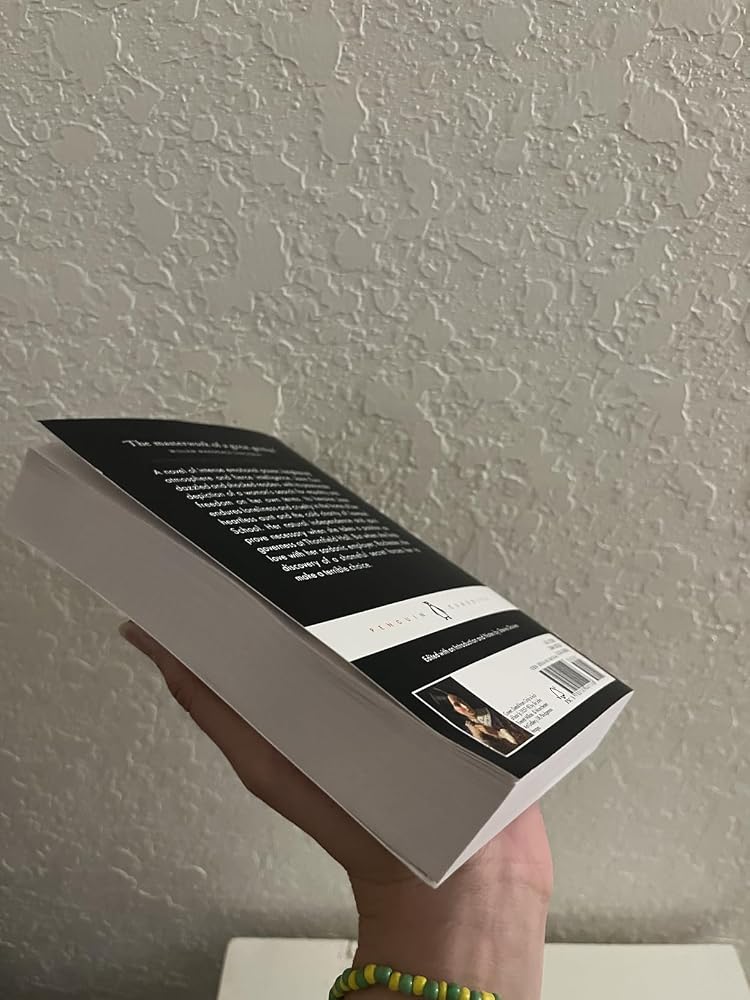
Can never really complain with a penguin classic!! They do what they do best!! Gorgeous copy, thank you !


Haven’t started it yet but mine actually came in pretty good condition! Just some minor wear along some edges but mine came in a box with some other items I had ordered so I suspect it’s from that. Didn’t really expect it to be in mint condition fresh from the press though lol. Can’t wait to start my first classic!

physical book is in good condition. was not missing any pages. worth the price

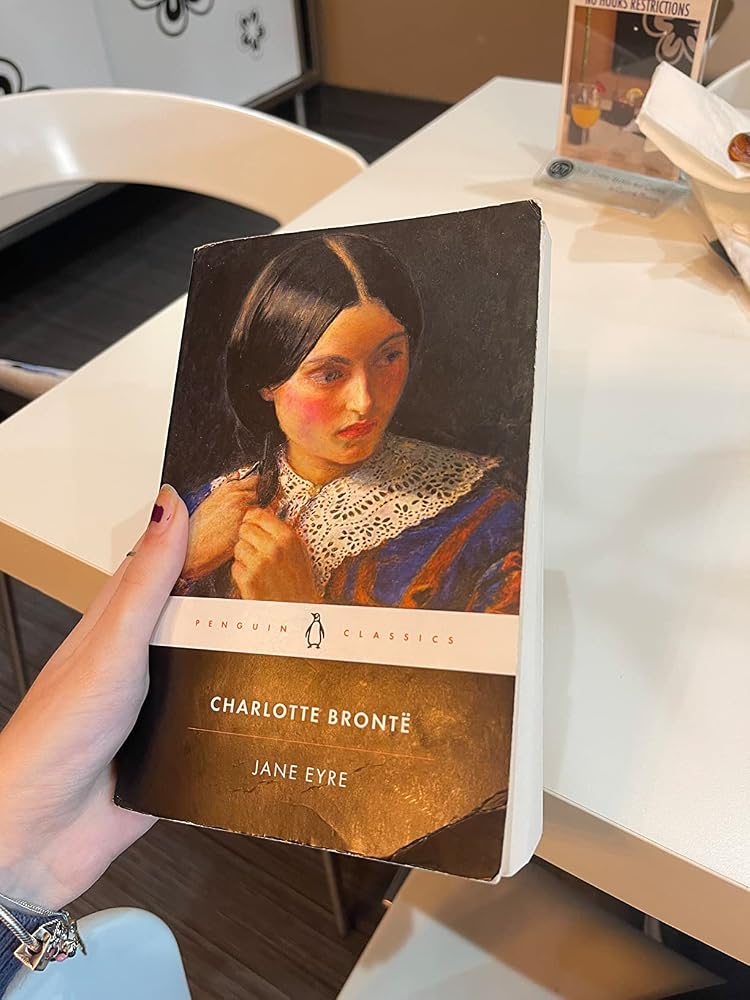
Arrived in perfect condition, as for the book: it is a masterpiece.


For such a cheap price I didn’t realize how thick the book was going to be haha, but overall good, came quick which I am grateful for, super excited to read!


It took me much longer to read this than anything I have read in a long while. As such, Jane and Edward are now my well known friends and I am happy to have met them both.
What words have ever expressed so well a complete and loving connection as those of Jane and Rochester when reunited after such terrible loss? Made all the more affectionate by those touching and revolutionary words, "Dear Reader."
Extraordinary story combined with extraordinary writing talent. This is Charlotte Bronte's masterpiece. I loved the way all the pieces fit together, even if I didn't love the end. I will read it again someday.
I so want to give this book five stars, and indeed higher than that, were I to limit my review to only certain sections. Alas, as Jane Eyre is a complete novel, and as such must be reviewed as a whole, I can only give four. I don't want to begin, or dwell on, the negative, so let me first say that I loved this novel and I highly recommend it to anyone looking for a memorable and, at times (many, many times), magnificently written piece of literature. Bronte is truly masterful, and there are characters, and scenes, from this work that I fondly recall as if they were intimates, which in a sense I suppose they were. The only negative comment is that Jane Eyre, is on a few (too long) occasions, uneven and clunky. But let's not focus on the crack rather than the gorgeous entirety of a gorgeous fresco. Jane Eyre is a memorable and important work of literature, and when it ended, I would have liked to hug Jane and thank her for sharing with me so much pathos, wisdom, and grit. Bravo!
Penguin Classics are always my go to... great editions. My only complaint is that it was delivered in a thin envelope and was bent on the corner and a bit bent on the front cover. That of course does not distract from the reading of this beautifully written classic. I love the narrative, written as an 'autobiography' of sorts and told from Jane's point of view. Definatly a new favorite of mine. My only wish is that I waited so long to finally read it!
This review contains spoilers.To preface this review, I was pleasantly surprised by how much I enjoyed a book from the 1800s. I probably would not have read Jane Eyre if it weren’t for a well-timed reference and a stoic challenge to read a classic. I went in blind, not knowing anything about Charlotte Brontë or her religious history.At times, I related more to Edward Rochester than Jane. He was closer to my age and more passionate. Jane could be frustrating and rigid at times, especially with religion. It stood out most in her interactions with St. John Rivers.He felt like a full-on zealot—using religion to manipulate. Although I suspect he was far too deep in his own ego regarding his religious crusade to be aware of that. But who knows. There's a quote from his sister describing him as a good man, while also saying he tramples "little" or "insignificant" people. Contradictory. He also repeatedly frames Jane’s refusal of marriage as moral weakness and positions himself as spiritually superior. He uses religious language (duty, God’s will, prayer) to pressure her into marriage.On the other side, Rochester at first felt a little too ungrounded, almost lacking real stability at times (though he was by far my favorite for his passion and interesting mind).Jane sat somewhere in between. And by the end, Rochester had changed—more balanced, a bit more spiritual, and a much better match for her. I also found it interesting that his dependence on her at the end of the novel was a selling point for her. A little icky, but I get it, and it suits Jane's character.Overall, a better age-gap love story than Twilight, with a more appealing Edward.
Today we think of all a student needs. This young girl was abused while those who were to take care of her did nothing. Yet, Jane found a way to become a marvelous and caring human being. She even cared for her first abusers who did nothing for Jane nor anyone else.This was a long and arduous task to complete but I didn’t need to accomplish what Jane did.
Good book
I have always loved this book how she finds her own way despite the hardship shown at her everybody should read this book
Excellent item expertly packed, speedily Excellent item expertly packed, speedily delivery. Thank you! delivery. Thank you!
No wonder it's a classic! So much intrigue and twists of fate, such great descriptions!I found it hard to put down and read it in 3 settings.I highly recommend it.Just because a book is from another time, that doesn't mean it isn't fantastic storytelling!!I felt like I was right there. Her descriptions made me feel like I could see the rooms, the orchards, the big tree, and the characters were so true to life and no different than people today, with the same kinds of egos and motives, kindnesses and cruelties.Great book!
The book itself is PHENOMENAL, but this version has some issues. Lines often repeat or are placed incorrectly. Additionally, the cover image is AI, which isn’t ideal. I’d look for another version.
As an author and avid reader, I love to revisit classics like Jane Eyre, a book I first read as a teenager. The eyes of a reader matter. When we’re young, we see things differently, so a novel affects us differently than when we’re older and our life’s experiences have unfolded. Such was the case with Jane Eyre, which I hadn’t read in a gazillion years. I, of course, have seen the many films and TV adaptations, so I remembered the gist of the story, and naturally my vision was colored by those interpretations. As a rule, actors are beautiful people, and those who’ve brought Jane and Mr. Rochester to life are always remarkably striking. Not so the actual characters that Charlotte Brontë created with an unflinching wretchedness that literally brings tears to the eyes. The two damaged, unattractive people who populate this novel are at times challenging to care about, even with the intensity of their suffering. Brontë is constantly reminding us that our hero and heroine are scarred.This is a tragic gothic novel; is there any other kind? Brontë recreates a world of station and hierarchy, with immaculate prose and attention to detail that is often missing in today’s novels. This is a leisurely journey that moves slowly through the characters’ lives. Brontë’s painstakingly presents the perspective of Jane—her thoughts, her dislikes, and her passions. Embracing this slow, detailed approach requires patience and appreciation for the craft involved.Classics are never an easy read. They require perseverance and commitment, but your effort will often be gratifying. I took my time and was rewarded thoroughly. If you’re a true lover of English novels, this is your read. Emily has been called the “first historian of the private consciousness,” a fitting moniker, indeed.
Increíble y hermosa historia desde el principio hasta el final lo recomiendo mucho leer esté libro maravilloso. Muchas Gracias Amazon📚📖
This book was very helpful in my Victorian literature class and I managed to stay afloat and not fail with it
The book is beyond incredible, but this particular version needs further editing. It is filled with misprints. However, great story!!
This version contains several repeat phrases at the end of dialogue. The story itself is, of course, worth the read, but if you're someone who likes flawless formatting, you'll need a different edition.
Excellent
This book is hard for me. The genius of the writer has caused me to stop often, unable to withstand suffering I have felt. Jane is incredibly brave, constant and intelligent. Life gives her rocks and shoals and she navigates them by using her virtues. This a book of inward struggle. If Lizzie had told Pride and Prejudice, it would have some of this but this is a wild and gothic world beyond the emotions of Netherfield.


